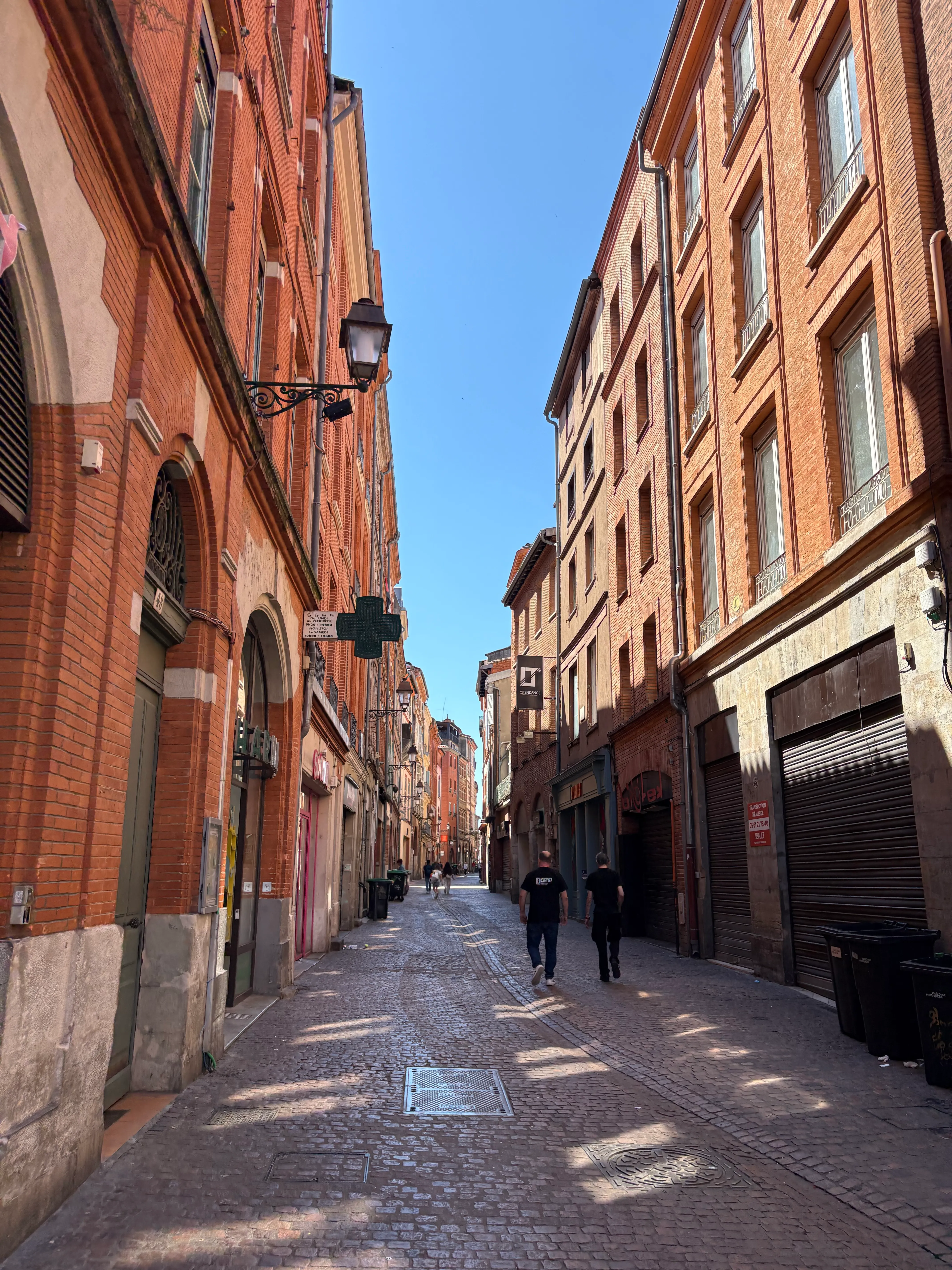
Toulouse is known as La Ville Rose — the Pink City — for the terracotta-pink brick that lines nearly every historic building in its center, a material choice that goes back to Roman times, when stone was scarce in the region but river clay wasn’t. It’s also been recognized in several recent rankings as one of France’s most liveable cities, and having spent time there, we don’t disagree. Toulouse’s location is part of why it became significant in the first place — sitting near the Pyrenees and roughly halfway between the Atlantic and the Mediterranean, it grew into a natural crossroads and trading hub long before it became the aerospace city it’s known as today.
Toulouse at a glance
- Best time to visit: Spring or fall.
- How many days you need: 2 days covers Toulouse itself comfortably. If you want to add Albi or Carcassonne, budget a full day for each — more on why below.
- Budget: In line with the rest of France covered on this site — roughly €15-25 per person per meal, with accommodation and local costs at a similar level to what we’ve noted for other French cities.
- Getting there: We came by train from Montpellier — about 3 hours, roughly €25/person with the Carte Avantage Adulte (see our Metz post for why that card is worth having). Toulouse is also well connected directly to Paris.
Should you add Albi or Carcassonne?
Both are genuinely worth it, but treat them as separate full-day trips rather than something to squeeze in.
Albi is a compact, striking town built around the same pink-brick tradition as Toulouse, anchored by its fortress-like cathedral — one of the largest brick cathedrals in the world — and the Toulouse-Lautrec museum, since the painter was born there. It’s an easy, self-contained day trip.
Carcassonne is the walled medieval citadel most people have seen in photos without knowing the name — a fully restored fortified city, dramatic from a distance and worth wandering slowly once inside. It’s a different kind of day entirely from Albi’s more intimate, brick-town feel.
Some agencies sell a combined Albi-and-Carcassonne day trip. We’d skip that option — it means a genuinely rushed visit to both, with a significant chunk of the day spent on the road between them rather than actually in either town. If you can, give each its own day.
The weekend
We arrived Saturday morning and started with a walking tour — a good call for a first visit, since it covered the city’s history, its main landmarks, where to eat and drink, and even what’s worth buying as souvenirs, all in about two hours.
After the tour, we had lunch at La Faim des Haricots, an all-you-can-eat vegetarian buffet with a genuinely impressive range of dishes — highly recommended, and a rare find for vegetarians traveling in this region. We took our time over a long lunch, then went back to rest — between the early train, the two-hour walking tour, and temperatures that were already uncomfortably hot, an afternoon break made sense.
In the evening, we headed back out. The walk from our hotel into the city center ran alongside the Canal de Brienne, a genuinely peaceful, tree-lined route that made getting into town feel like a proper walk rather than a slog. Our first stop, on our guide’s recommendation, was Chez Tonton — an iconic Toulouse institution, owned by a woman in her 90s, where university students and working professionals mix easily, and where the local rugby team is known to celebrate after matches. The square it sits on is a genuine neighborhood hub, hosting Sunday markets as well.
From there we walked further into the city center, and had dinner at Marcello, a pizza spot that’s earned its reputation — highly recommended.
What to see
- Le Capitole — Toulouse’s town hall, a grand neoclassical building whose facade and interior halls hold genuinely striking artwork; it also houses the Capitole Theatre.
- Couvent des Jacobins — a 14th-century Gothic convent, notable for its distinctive palm-tree-shaped vaulted ceiling, and home to the relics of the theologian Thomas Aquinas.
- Basilique Saint-Sernin — one of the largest Romanesque churches remaining in Europe, and a significant stop on the historic Camino de Santiago pilgrimage route.
- St. Étienne Cathedral — architecturally unusual, having been built and rebuilt piecemeal over centuries, which gives it a genuinely mismatched, patchwork character rather than one unified style.
- Canal du Midi — a 17th-century engineering feat built under Louis XIV, designed to connect the Atlantic and Mediterranean by water; now a UNESCO World Heritage site and a pleasant walking route in its own right.
- Pont Neuf — despite the name (“New Bridge”), it’s actually Toulouse’s oldest bridge over the Garonne, and a genuinely good spot to watch the city’s pink brick catch the evening light.
The regret
Here’s an honest one: as an aviation enthusiast, it somehow didn’t register until I was actually boarding our flight out of Toulouse that this is Airbus’s headquarters. Tours of the Airbus facilities exist — they start at the Airbus Discovery Centre near Toulouse-Blagnac Airport, run about 1.5 hours, and need to be booked online well in advance, since slots fill up and walk-up tickets are rare, especially in peak season. Photography isn’t allowed once inside. If you’re even slightly interested in aviation, book this before you arrive — don’t make my mistake of remembering on the way out.
Frequently asked questions
How many days do I need in Toulouse? 2 days covers the city itself. Add a full extra day each for Albi and Carcassonne if you want to include them — don’t try to combine both into one rushed day trip.
Why is Toulouse called the Pink City? Its historic buildings are built from a distinctive terracotta-pink brick, a material choice dating back to Roman times when local stone was scarce but river clay was abundant.
Is Toulouse worth visiting beyond the Airbus connection? Absolutely — its food, architecture, and genuinely liveable pace stand on their own, Airbus aside. That said, if aviation interests you, book the factory tour in advance; it’s easy to miss otherwise.
Should I do Albi and Carcassonne as one combined day trip? We wouldn’t recommend it — it rushes both and eats a large chunk of the day in transit. Give each its own full day if you can.