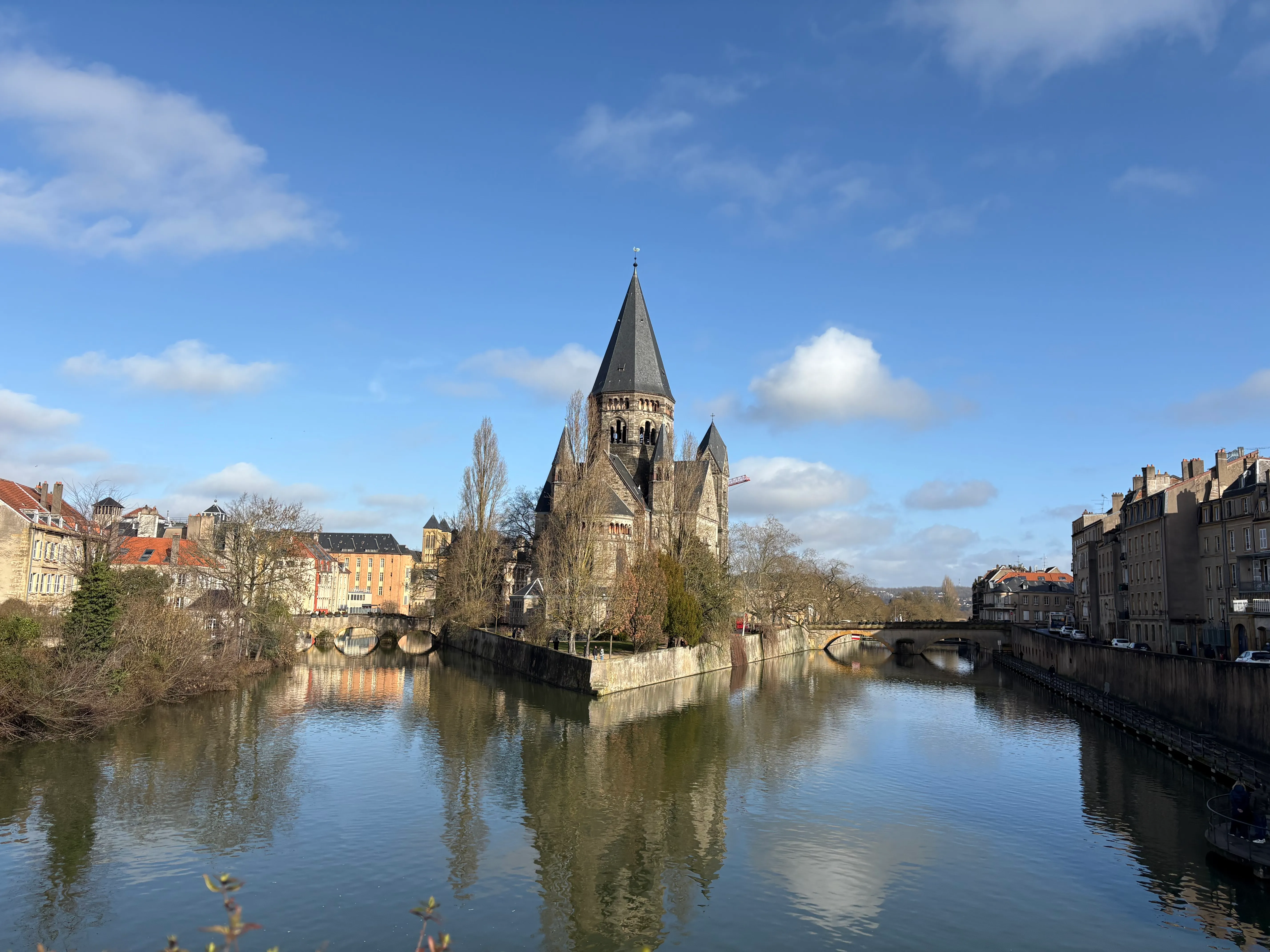
My wife’s semester abroad ran from January 12th to May 6th, based in Metz — a city in the Lorraine region, near France’s borders with Germany and Luxembourg. I joined her, on and off, for most of it. This post is about Metz itself and what it’s like to live there for months rather than pass through; every weekend trip we took from this base — Reims, Strasbourg, Sedan, Charleville-Mézières, Longwy, Trier, Frankfurt, Freiburg, Basel, Luxembourg, and eventually Belgium — gets its own post, linked below. Once the program ended, we kept traveling south through France and on to Greece; that continuation is linked separately further down, since it wasn’t based out of Metz anymore.
The visa logistics nobody tells you about
If you’re planning something similar — accompanying a partner on a semester abroad — the Schengen 90/180 rule matters more than you’d think. As an Indian passport holder, I could only stay in the Schengen zone for 90 days within any 180-day period, even though my wife had a student visa covering the full program.
That shaped our whole trip. I was in Metz from January 9th to February 6th, then had to leave. I was meant to return the week after Holi, but the timing collided with the Iran-US-Israel conflict — my return flight (Emirates via Dubai) was the day after a strike hit Dubai airport, which made for a genuinely tense journey. I made it back to Metz on March 21st and stayed until April 12th, at which point I’d used up my Schengen days again. Since I still had a 5-week stretch to use in May-June, I went to Turkey for the gap — outside the Schengen zone, and far enough from the Middle East that I didn’t want to route back through that region a second time. I returned to Metz on May 6th to help pack up and start a month-long trip across France and Greece.
If you’re doing anything similar, count your Schengen days carefully before you book anything — it will dictate your itinerary more than you’d expect.
Metz at a glance
- Best time to be based there: Spring or fall. Winters are cold and windy, with short days — sunrise around 8-9am, sunset by 4-5pm.
- Accommodation: University-provided housing ran about €700/month, including utilities and furnishings — on the higher end, but worth it for the visa paperwork alone (see below).
- Food: A sit-down meal runs €15-25 per person with drinks. Groceries are reasonable — a baguette or croissant is €0.75-1.50, milk around €2/liter, and most vegetables ran about €3 for their standard package size — a kilo of tomatoes or a 250g pack of spinach, for example.
- Connectivity — this is Metz’s real advantage: Paris is 2 hours by high-speed train (tickets from €19, cheaper if you catch a resale/swap listing) or 4.5 hours by bus. Frankfurt is 2.5 hours by train. Luxembourg is under an hour and just €9 by local train. Brussels is 3.5 hours via Luxembourg. Metz sits on the high-speed line and on several Paris-originating bus routes, so it’s genuinely one of the best-connected small cities in France for weekend trips — which is the whole reason this became a hub of trips rather than just one destination.
Buy the Carte Avantage Adulte before you start train-hopping
If you’re traveling around France by train, especially on weekends, get the Carte Avantage Adulte — it costs €49 for the year and gets you a 30% discount on TGV INOUI and Intercités fares (25-50% on regional TER trains), plus it covers one accompanying adult on the same card, not just the cardholder. It also extends to some cross-border routes, including Luxembourg and parts of Germany. Given how expensive French train travel can get, this pays for itself within 4-5 legs, often fewer — and if you’re doing anything like the weekend-trip pattern in this post, you’ll clear that easily.
Why a university-provided address mattered for the visa
If you’re accompanying a student, having accommodation on the university’s letterhead — explicitly naming you as an approved co-resident — made visa applications significantly smoother than trying to arrange private accommodation and get a landlord to produce the same documentation. Every time either of us traveled or applied for anything, we needed to show proof of accommodation, and having that sorted institutionally saved a lot of friction.
Is Metz itself worth seeing, or just a good base?
A bit of both. It’s not a place you’d fly in specifically to see, but it earns a day of wandering if you’re already there. The city center is pleasant, Porte des Allemands is worth a look, and Fort de Queuleu is genuinely worth the visit — it was used as a detention site for people resisting the Nazi regime during the occupation. Today it’s a quiet, humbling place: the old prison cells sit reclaimed by nature, and locals walk their dogs and run through what used to be a place of real suffering. It’s not a typical tourist stop, but it’s the one place in Metz that stayed with us.
Beyond that, Metz is simply a good city to live in — clean, well-run public transport, less traffic than major French cities (outside city-center rush hour), and a large student population that keeps things lively, especially Thursday nights around the center. There’s real green space too — a river runs through the city with well-kept paths along both banks, plus big parks and a lake. Locals run and cycle throughout the city, and especially through these green areas.
What we noticed about people, living there for months
People were consistently warm — smiling, saying “Bonjour” and “Au Revoir” unprompted, helping when asked. Nobody assumed we didn’t speak French; the first interaction was always in French, which felt respectful rather than exclusionary. Institutions — both government offices and private businesses — were generally more relaxed than we expected, sometimes a little too relaxed for our liking (more on that in the Paris phone theft story, where it mattered in a very specific way).
Weekend trips from this base
- Reims: A Weekend Stopover in Champagne Country
- Sedan, Charleville-Mézières & Longwy: An Off-the-Beaten-Path Weekend
- A Strasbourg Weekend
- 9 Days in Paris (plus the phone theft story, a post of its own) — technically longer than a weekend, since it doubled as our wind-down once the program ended, but still reached directly from Metz
- Trier, Frankfurt, Freiburg, Basel, Luxembourg, and our two Belgium trips (Brussels and Antwerp) — coming soon
After Metz: a month across France and Greece
Once the program ended, we left Metz for good and kept traveling — but from this point on, we weren’t based in Metz anymore, so these aren’t “weekend trips from this base” in the same sense. The route ran from Paris down to the Mediterranean coast, then on to Toulouse, continuing into Greece.
- Montpellier & Carnon: A Quieter Alternative to the French Riviera
- Toulouse: The Pink City
- 10 Days in Athens
Frequently asked questions
Is Metz worth visiting on its own, or only as a base? It’s primarily a base — a genuinely excellent one — but Fort de Queuleu alone is worth a half-day if you’re already there.
What’s the best time of year to be based in Metz? Spring or fall. Winter is workable but cold, windy, and short on daylight.
How well-connected is Metz for day and weekend trips? Very. Paris, Frankfurt, and Luxembourg are all within a few hours, and it sits on France’s high-speed rail line, which makes it one of the best small-city bases we’ve found for this kind of trip.
Do I need to worry about the Schengen 90-day rule if I’m accompanying a student on a long visa? Yes, seriously — the student’s visa doesn’t extend to an accompanying partner unless specifically arranged. Count your 90-in-180 days before you plan anything, since it will likely force a mid-program gap like ours did.