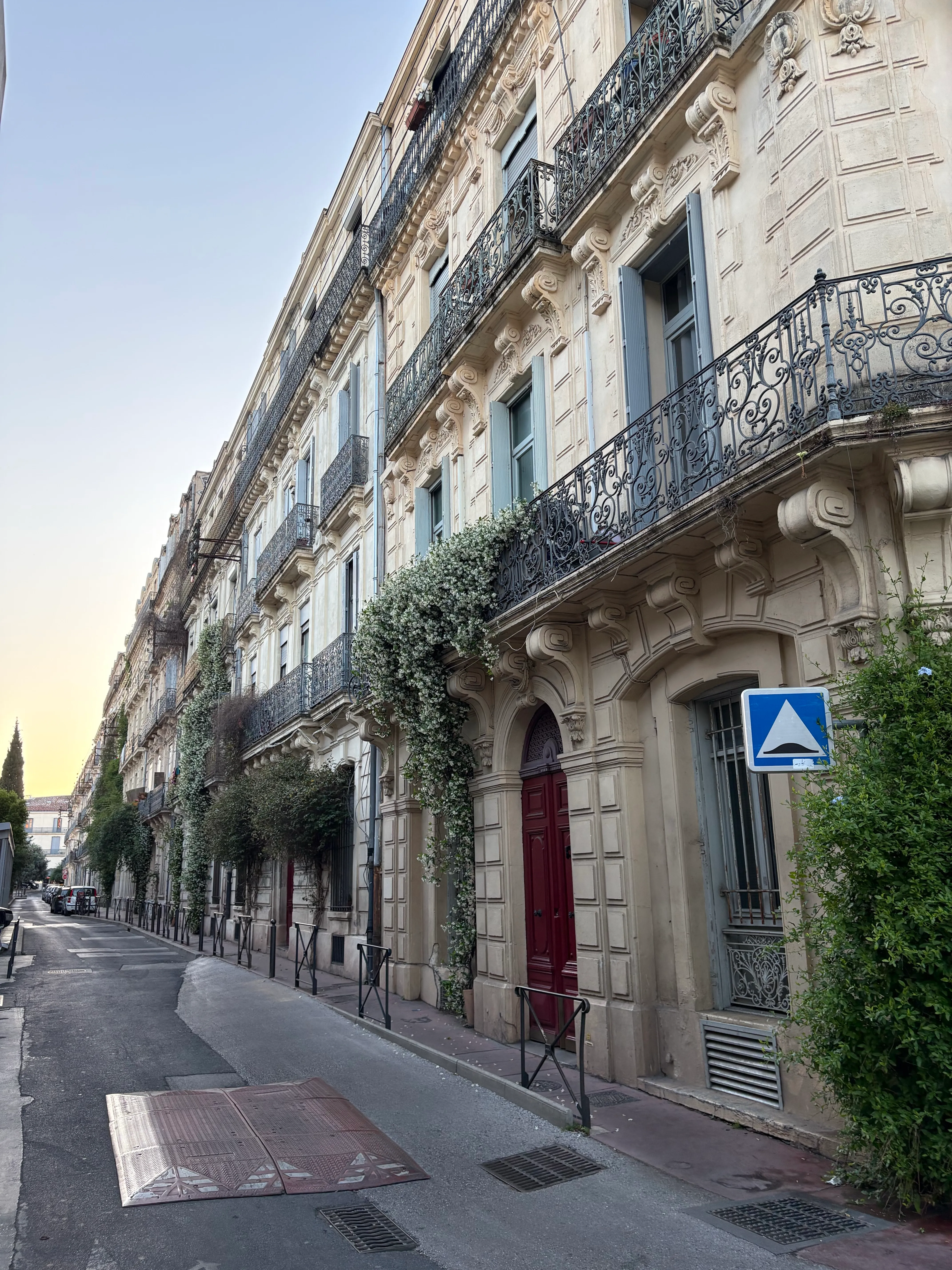
We wanted the French Riviera experience — the beaches, the Mediterranean, the whole idea of it — without the crowds that come with Marseille or Nice. So we based ourselves in Carnon for a week instead, with Montpellier a short trip away. My wife actually visited Nice separately, a week-long trip at the end of February — maybe I’ll talk her into writing that post herself, since I clearly wasn’t there for it. As I mentioned in our Paris post, I generally prefer the less-traveled version of a place over the obvious one, and this was exactly that instinct applied to the coast.
At a glance
- Best time to visit: Spring or fall.
- How many days you need: Montpellier itself is a comfortable 1-day visit. If you want to add Sète or Nîmes, treat each as its own full day trip — both are genuinely worth it (see below).
- Budget: Carnon runs slightly cheaper than Montpellier, though there are far fewer accommodation options to choose from. Montpellier itself is in line with the rest of France covered on this site.
- Getting there: High-speed train from Paris to Montpellier Sud de France station, then a cab to our Airbnb in Carnon.
A week in Carnon
The whole point of Carnon was to slow down — relaxing by the beach, in water that was mildly cold under a mildly hot sun, without needing to be anywhere or see anything in particular. We went into Montpellier twice during the week, which was plenty.
Getting into Montpellier from Carnon
We took the bus from Carnon to Pérols, then the tram from Pérols into the city center. One thing worth clearing up: you may see claims that Montpellier has made all public transport free — that’s true, but only for residents of the metropolitan area, who need a specific pass to use it. As a visitor, you’ll still pay: the bus from Carnon (which appears to be a separate, private service) cost us €2, and the tram itself requires a ticket bought from the vending machines found at most stations. One quirk worth knowing: we didn’t see any scanning machines inside the trams themselves, unlike the clearer setups we saw elsewhere.
What to see in Montpellier
- Aqueduc Saint-Clément (also called the Aqueduc des Arceaux) — an 18th-century aqueduct built to carry water 14km from the Saint-Clément spring to the city, designed by an engineer who drew inspiration from the much older Pont du Gard. Its long run of arches is genuinely one of the more striking things to walk alongside in the city.
- Cathédrale Saint-Pierre — a fortified 14th-century Gothic cathedral with twin pointed towers, originally built as a chapel for the adjoining Faculty of Medicine — one of Europe’s oldest continuously operating medical schools, which tells you something about how old this part of the city really is.
- Jardin des Plantes — France’s oldest botanical garden, established in 1593 under King Henri IV. Free to enter, and a genuinely peaceful break from the city center.
- Place de la Comédie — the city’s central square, nicknamed “L’Œuf” (The Egg) for its shape, anchored by the 18th-century Opéra Comédie. It’s the natural starting and ending point for any walk through the city.
Where to eat
Chunxi Le Coin Nouilles in Montpellier for noodles, and back in Carnon, French Naan and Le Libanais — both worth going back to more than once during a week-long stay.
Should you add Sète or Nîmes?
Both, if you have the days for it — each deserves its own full trip rather than a rushed half-day.
Sète is nicknamed the “Venice of Languedoc” for the network of canals running through its center, lined with colorful fishing boats and waterfront houses. It’s a genuine working fishing port, not a polished tourist set piece, with excellent seafood and a viewpoint from Mont Saint-Clair worth the climb.
Nîmes is often called the “French Rome,” and it earns the name — the Arena of Nîmes is one of the best-preserved Roman amphitheaters anywhere, and the Maison Carrée nearby is a fully intact Roman temple, a rarity even by Rome’s own standards. If Roman history interests you at all, this is one of the most rewarding day trips in the region.
Frequently asked questions
Is Montpellier/Carnon a good alternative to Marseille or Nice? Yes — if what you actually want is Mediterranean beaches and a relaxed pace without the crowds those two cities draw, this stretch of coast delivers that directly.
Is public transport really free in Montpellier? For residents of the metropolitan area, yes, with a specific pass. As a visitor, you’ll still pay for buses and trams — don’t assume otherwise.
How many days do I need for Montpellier, Sète, and Nîmes together? Budget 1 day for Montpellier itself, plus a full separate day each for Sète and Nîmes if you want to include them — don’t try to compress all three into one trip.
Is Carnon a good base, or better to just stay in Montpellier? Carnon is cheaper and puts you right on the beach, but has far fewer accommodation options. If beach time is the priority, Carnon is the better call; if you want more restaurant/lodging variety, Montpellier itself works too.