This wasn’t originally the plan — it turned into one out of necessity. Landing at CDG with a couple of days to kill before our university-provided accommodation opened up in Metz, we looked at the options: the direct train from CDG to Metz was expensive, and the bus took 4.5 hours. Reims had a direct bus from CDG at just 2.5 hours, so we stopped there instead. It turned out to be a good call.
At a glance
- Getting there: Direct bus from CDG airport, about 2.5 hours.
- Best time to visit: Spring or fall — though be aware winter closes some of the region’s biggest draws (see below).
- Budget: Stay ran €40-80/night depending on the property and whether breakfast was included. A 24-hour local transport pass cost us €6 for the two of us. Food matched the general France budget — €15-25/person per meal. Pastries at bakeries ran €1-5, coffee €2.50-6. If you’re taking the train, the Carte Avantage Adulte is worth having — see our Metz post for why.
The weekend
We landed exhausted — a long haul from Hyderabad via Doha to CDG, then the bus to Reims — so after checking into our hotel (booked deliberately near the Champagne-Ardenne bus stop, since we had an onward bus to Metz on Sunday), we rested before doing anything.
Once we headed out, Reims’ tram wasn’t running — a replacement bus was operating instead, a short 2-3 minute walk from our hotel (steep uphill one way, steep downhill the other). We took it into the city center and spent the afternoon walking around several landmarks:
- Notre-Dame de Reims — the cathedral where French kings were traditionally crowned for centuries, making it one of the most historically significant churches in the country, not just an architecturally striking one.
- Place Drouet d’Erlon — the city’s main pedestrian square, lined with cafes, bars, and restaurants; this is where Reims’ evening energy actually lives.
- Place Royale — an elegant 18th-century square built around a statue of Louis XV, in the more formal, classic French royal-square style.
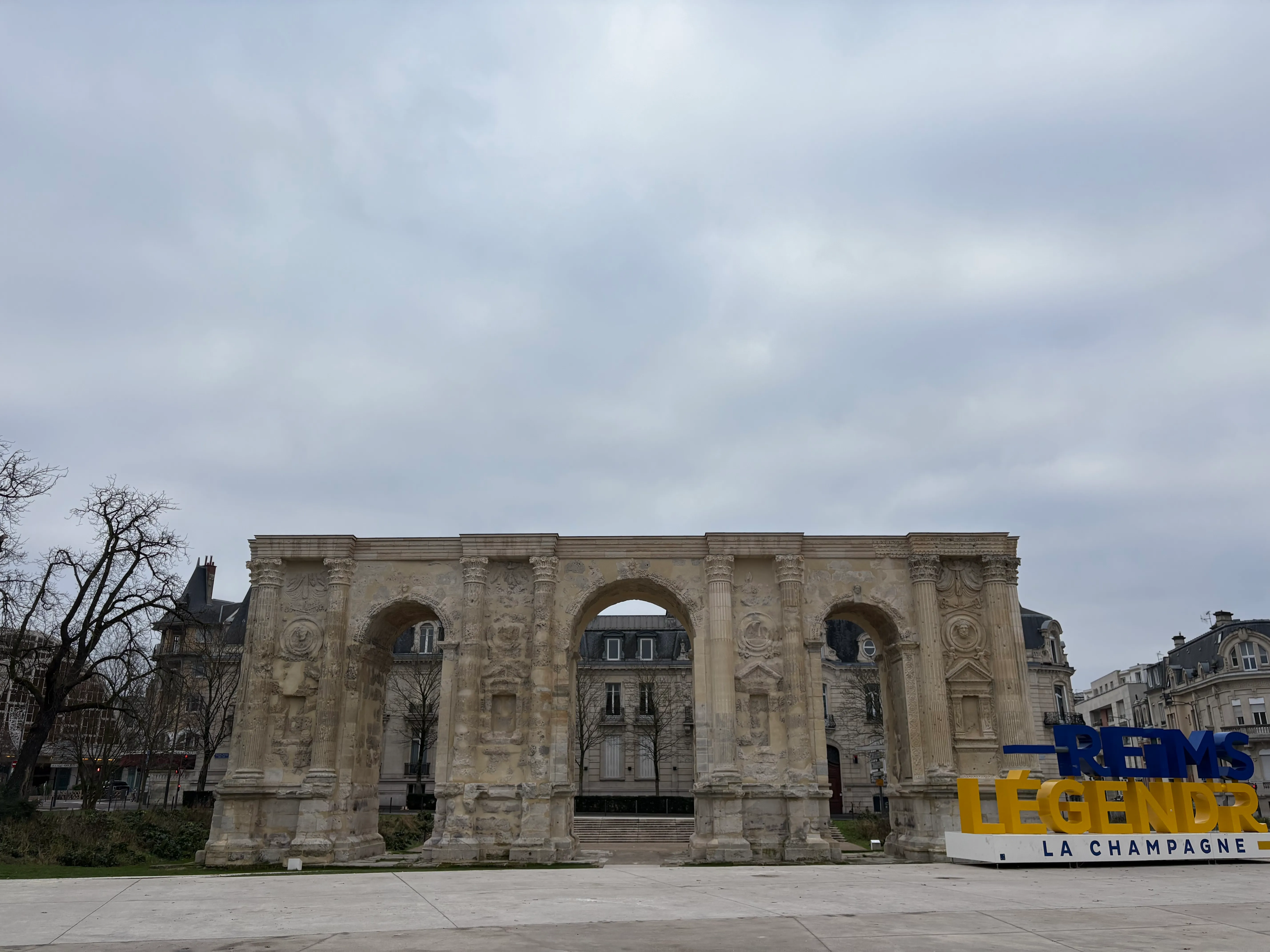
- Porte de Mars — a Roman triumphal arch, and one of the largest surviving Roman gates anywhere, a reminder that Reims (Roman-era Durocortorum) predates its medieval and royal history by centuries.
What’s worth naming
Cafe Feuillette stood out enough to remember — we only walked in because it was packed with locals and had almost no free tables, which felt like a better signal than anything else. Worth knowing: if you check Google Maps first, its rating sits around 3.6, which might talk you out of going — don’t let it; being full of locals told us more than the star rating did. Macarons ran about €1 each; other pastries €1-5.
The one thing to know before you go
Reims is famous for its champagne houses, and we’d assumed a tour would be part of the visit. It wasn’t — the tours we wanted were closed, likely due to the season/weather. If a champagne house visit matters to your trip, check opening schedules before you build a Reims stop around it — this isn’t guaranteed to be open outside peak season.
Frequently asked questions
Is Reims worth a stopover on the way to elsewhere in France? Yes, especially if you can get a good direct connection like the CDG-Reims bus we used — it turns dead travel time into an actual short trip.
Can I do a champagne house tour on a winter visit? Not guaranteed — several were closed when we visited. Check specific opening schedules in advance if a tour is the point of your trip.
Do I need a car in Reims? No — a short-term local transport pass covered everything we needed within the city.